Employee wellness is the practice of supporting workers’ physical, mental, and social health through workplace programs, policies, and resources. It covers everything from fitness perks to stress management support, and it shapes how people feel about coming to work every day.
Close to half of employees worldwide report feeling burned out on a regular basis, and Gallup’s research on employee well-being ties that burnout directly to lower engagement and weaker performance. That single fact explains why more HR teams treat wellness as a business priority rather than a perk.
In this article, we’ll break down what employee wellness really means, why it pays off, and how to build a program your team will actually use.
What is employee wellness?
Employee wellness is a company’s structured effort to protect and improve the physical, mental, financial, and social health of its workforce. It rests on a simple premise: employees who feel well tend to perform better, stay longer, and engage more fully with their work.
Most employee wellness programs share three goals. They aim to improve overall employee health, lower healthcare costs tied to preventable conditions, and reduce common workplace health risks such as chronic stress, poor sleep, and sedentary habits.
These risks are not abstract. Unmanaged stress and related conditions drive real medical costs and lost productivity for employers, which is why a proactive wellness strategy pays for itself over time.
Wellness and employee care overlap heavily, since both start from the same question: what does this person need to do their best work sustainably?
Employee wellness vs. workplace well-being: What’s the difference?
The two terms get used interchangeably, but they are not identical. Employee wellness usually refers to specific programs and benefits, such as gym stipends, mental health apps, or biometric screenings.
Workplace well-being is broader. It includes wellness programs but also covers culture, management quality, workload, and psychological safety. A company can offer excellent wellness perks and still have poor well-being if managers are dismissive or workloads are unsustainable.
Understanding this distinction matters because a wellness program alone will not fix a toxic culture. Programs work best when they sit inside a genuinely supportive environment.
Why does employee wellness matter?
Employee wellness matters because it directly affects productivity, retention, and healthcare spending, three of the biggest cost centers on any HR budget. A workforce that feels physically and mentally supported shows up more consistently and does better work.
Consider the financial angle first. Gallup has estimated that disengagement tied to burnout and low well-being costs the global economy hundreds of billions of dollars in lost productivity every year. That cost lands on individual employers in the form of absenteeism, turnover, and quality issues.
The benefits break down into a few clear categories.
- Productivity gains. Employees with better physical and mental health tend to concentrate longer and produce higher-quality work.
- Lower absenteeism. Preventive support reduces the sick days and medical appointments that pull people away from their desks.
- Reduced healthcare costs. Encouraging healthy behaviors early tends to reduce claims tied to chronic, preventable conditions over time.
- Stronger retention. People stay longer at organizations that visibly invest in their well-being, a pattern closely tied to overall employee engagement.
- Better culture. Wellness initiatives signal that leadership sees employees as people, not just output.
None of these benefits show up overnight. They compound as trust in the program builds and participation grows.
What are the benefits of an employee wellness program?
An employee wellness program pays off in engagement, retention, and workplace culture, often before it shows up in hard financial numbers. The effects tend to surface in this order.
Higher engagement and lower turnover
Stress is one of the top reasons people disengage from their jobs or take unplanned time off. When wellness programs address stress directly, through mental health resources or workload adjustments, morale improves, and teams collaborate better.
Employees who feel appreciated are also more likely to stay. A visible wellness program tells people the company sees their well-being as worth investing in, which strengthens loyalty during periods when competitors are actively recruiting.
A stronger employer brand
Wellness initiatives often reflect a company’s actual values, not just its stated ones. Executive support for well-being programs is one of the more reliable signals job seekers look for when comparing offers.
More productive employees
Over half of workers believe their productivity and their wellness are directly connected, which tracks with what most managers observe firsthand. When people are not distracted by untreated stress or physical strain, they bring more focus to their actual work.
How do you start a workplace wellness program?
Starting a workplace wellness program takes five deliberate steps: assess needs, secure leadership support, design the program, promote it, and measure results. Skipping any one of these steps tends to produce a program nobody uses.
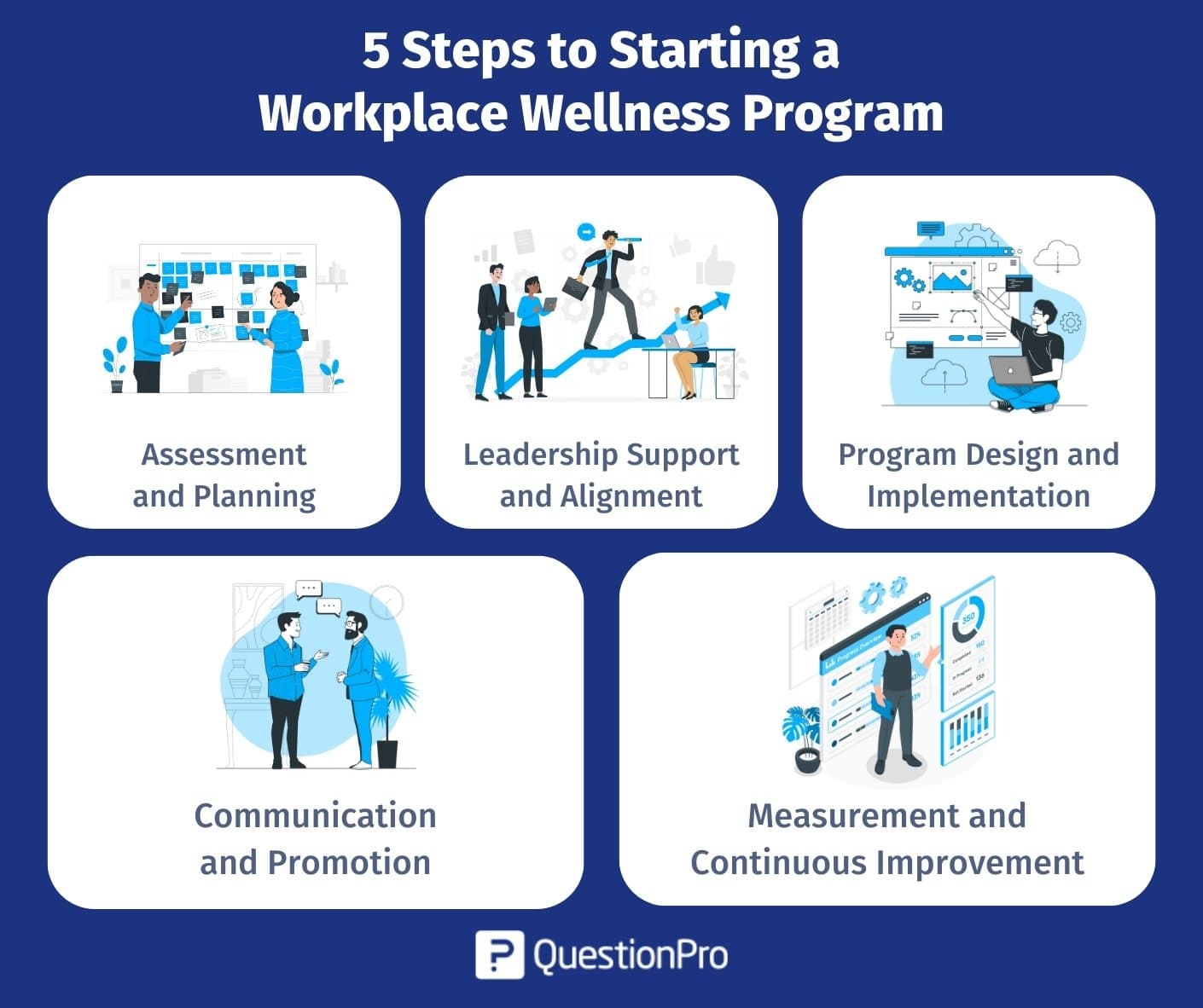
- Assess needs and set a plan.
Run an employee pulse survey about wellness preferences, stress points, and goals before building anything. A program built on assumptions rarely lands well.
- Get leadership buy-in.
Executive support secures budget and signals that the program matters, not just to HR but to the whole organization.
- Design and build the program.
Mix physical, mental, and financial wellness offerings based on what the assessment revealed. Bring in outside experts for anything clinical, like counseling access.
- Communicate and promote it.
Use email, team meetings, and internal channels to explain what is available and why it matters. A program nobody knows about might as well not exist.
- Measure and improve.
Track participation, gather feedback, and adjust the offering every few months instead of treating the launch as the finish line.
What are the best practices for employee wellness?
Effective employee wellness combines regular listening, practical resources, and a workplace designed to reduce avoidable stress. The practices below cover the areas that tend to have the biggest impact.
| Practice | What it looks like |
|---|---|
| Run regular wellness surveys | Ask employees directly what would improve their health and productivity at work |
| Offer safety training | Provide regular training on handling workplace hazards and injury response |
| Stock healthy snacks and water | Make nutritious options available during breaks |
| Invest in ergonomic setups | Provide adjustable desks and proper seating to reduce physical strain |
| Allow flexible scheduling | Let employees manage appointments and family needs without penalty |
| Address specific stressors | Identify what is actually causing stress and fix it directly |
| Provide wellness resources | Offer access to fitness spaces, nutrition guidance, or wellness content |
| Encourage real breaks | Support short walks or rest periods throughout the day |
| Support mental health checks | Offer confidential access to counseling or psychological support |
| Build team connection | Run team-building activities that strengthen relationships across the org |
Picking two or three of these to start, based on employee feedback, tends to work better than launching all ten at once.
How do you measure the success of a wellness program?
You measure wellness program success by tracking participation rates, health outcomes, and engagement scores over time, then comparing them against your original goals. A program without measurement is just a set of good intentions, and reviewing employee turnover trends alongside participation data shows whether wellness efforts are actually improving retention.
Useful metrics include:
- Participation and completion rates for specific offerings
- Changes in absenteeism and sick leave usage
- Employee engagement or satisfaction scores from pulse surveys
- Healthcare claims trends where data is available
- Voluntary turnover rates before and after launch
Running short pulse surveys every quarter gives HR teams a faster read on whether a program is working than waiting for annual engagement results alone.
What common mistakes weaken wellness programs?
The most common mistake is designing a program around trends instead of actual employee needs, which leads to low participation regardless of how much the perks cost. Free gym memberships do little for a team that says its biggest stressor is unmanageable workload.
Other frequent missteps include launching a program without leadership visibly participating, failing to promote it consistently after launch, and never revisiting the offering once it is live. Programs that stay static for years often lose relevance as the workforce changes.
A wellness program that ignores mental health support is also increasingly out of step with what employees expect. Physical perks alone no longer meet the bar.
How QuestionPro Employee Experience supports wellness programs
Building a wellness program that actually fits your workforce starts with knowing what your employees need, not guessing. QuestionPro Employee Experience helps HR teams run pulse surveys, well-being check-ins, and feedback loops that reveal where stress and dissatisfaction are concentrated.
That data makes it easier to prioritize the right initiatives, track whether participation and sentiment improve after launch, and adjust the program instead of running it on autopilot for years. You can explore the QuestionPro Employee Experience platform to see how ongoing feedback fits into a wellness strategy.
Building a wellness culture that lasts
A wellness program only works long-term if it becomes part of how the company actually operates, not a one-time initiative announced in a newsletter. That means revisiting it as often as you revisit any other business priority.
The organizations that get this right treat employee feedback as an ongoing input, not an annual formality. They adjust based on what people say, and they let managers model the behaviors they want to see, like taking real breaks and using flexible schedules themselves.
Frequently Asked Questions (FAQs)
Employee benefits are the full package of compensation extras, including insurance and retirement plans. Employee wellness is a subset focused specifically on health-related programs, such as fitness support, stress management, and mental health resources.
Budgets vary widely by company size and industry, but most organizations start small and expand based on participation data. A phased approach, beginning with low-cost initiatives like flexible scheduling, often works better than a large upfront investment.
Yes. Flexible scheduling, mental health day policies, and regular check-ins cost little but address the stressors employees report most often. Scaling up with paid perks can come later, once you know what employees actually value.
Evidence suggests preventive wellness efforts can lower long-term healthcare spending by reducing claims tied to chronic, preventable conditions. Results vary by program design, so tracking claims data over multiple years gives a clearer picture than short-term snapshots.
Quarterly pulse surveys tend to strike the right balance between staying current and avoiding survey fatigue. Pair them with one deeper annual assessment to catch longer-term shifts in employee needs.